
Where the Magic Happens: Building LSS Family Centered Treatment One Living Room at a Time
They weren’t a textbook family. A grandparent and a grandchild—two generations shaped by decades of different worlds—sat in their living room, trying to figure out how to belong to each other. On paper, circumstances had placed them under the same roof. What happened next—the slow, deliberate work of learning to trust, to communicate, to imagine a future together—was something else entirely.
When a therapist from Lutheran Social Services of Wisconsin and Upper Michigan (LSS) walked through their door, she didn’t arrive to deliver answers. She came to sit with them. To listen. To understand what was already working, and then to help them practice—right there, in their own home—what working could look like. Over the next six months, those living-room conversations became the foundation for real change. By the time the program ended, the family had something many of them hadn’t felt in a long while: direction, and the belief that they could move forward together.
Stories like this unfold every day across twenty-eight counties in Wisconsin through LSS’s Family Centered Treatment (FCT) program.
“Those are the ones that stay with me,” says Emily Klingenberg, FCT Program Supervisor. “When families walk away and know how to handle their problems—when they have connection again, when they have hope for what’s coming next.”
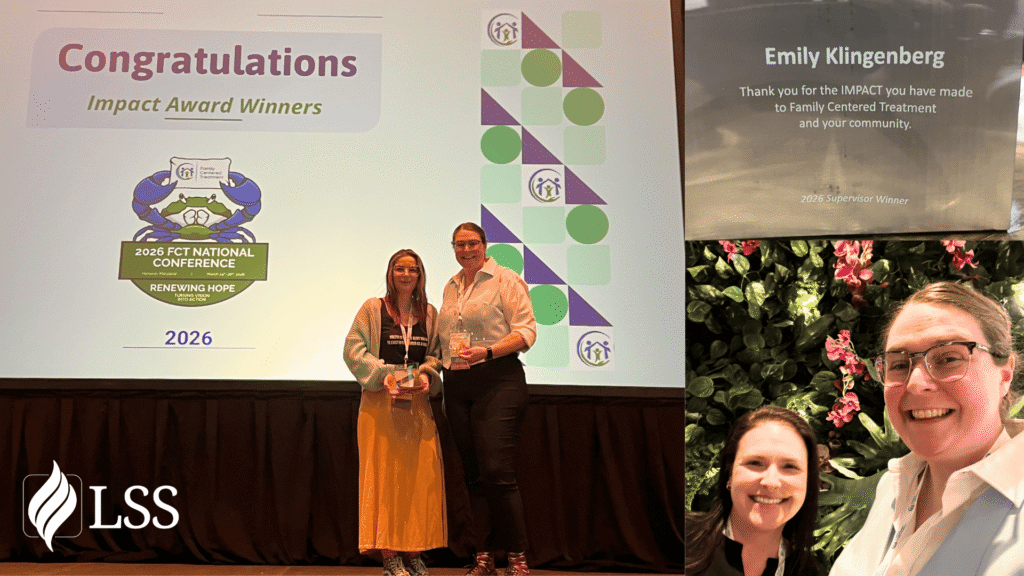
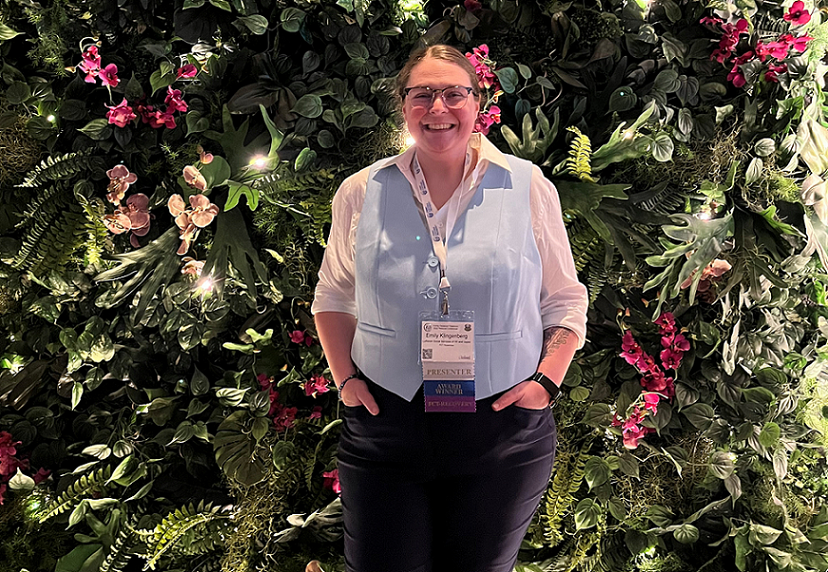
Emily has spent the past eight years building LSS’s FCT program from the ground up. That work has now been recognized on a national stage. In 2026, Emily was named Supervisor of the Year by the National Family Centered Treatment Foundation, Inc., an honor awarded every two years at the Foundation’s national conference in Maryland.
Emily is quick to tell you the award does not belong to her alone.
***
Family Centered Treatment is an evidence-based, in-home therapy model built around a simple idea: if you want to help a family change, go where they live. Programs typically last six months. During that time, LSS therapists partner with families in their homes and communities to identify what isn’t working, understand why, and practice—not just talk about—what change looks like.
“We are not a talk-therapy program,” Emily says. “Yes, there are conversations. But we’re practicing the things families say they’re struggling with. If the after-school routine is chaotic, I’m going to be there after school. Let’s see what’s actually happening. Tomorrow, we try it a different way.”
The model works on two levels: the daily stressors families face and the deeper wounds beneath them. Trauma. Broken trust. Patterns passed down across generations. FCT addresses both, and families who have been through multiple services before often feel the difference.
“I hear all the time, ‘This feels different,’” Emily says. “We don’t come in as experts telling people what to do. We partner with families. We help them make decisions and then support them in following through on the decisions they’ve made.”
At the center of that approach is a belief Emily holds without hesitation: every family already has strengths. The work is finding them and building from there.
***
Family Centered Treatment wasn’t part of Emily’s original plan. She came to LSS straight out of graduate school, working as a clinician in a different evidence-based program and doing the work she had been trained to do. Feedback from community partners eventually made it clear that while the program was helpful, it wasn’t reaching families in the ways they needed most.
Then came a suggestion from an unexpected place. A county funder asked whether LSS would consider offering Family Centered Treatment, a model already being piloted by a team in St. Croix County. LSS explored the option, recognized its potential impact, and said yes.
Emily’s colleagues knew immediately she should lead it.
The population FCT served was what drew her in. Before LSS, Emily spent her internships and early career in residential treatment, where she watched young people learn real skills in highly structured environments, only to return home to families who hadn’t had the chance to learn alongside them.
“The gap was visible,” she says. “And it bothered me.”
FCT felt like the missing piece: a model built around strengthening families rather than separating them.
“I’ve always believed in community-based care,” Emily says. “Going to people. Meeting families in their own homes. That’s where the magic happens, because you’re in the place they live every single day.”
***
Emily earned her full clinical license in October 2018. By November, she had stepped into the supervisor role for a brand-new program in a model she was still mastering herself. LSS understood the risk. They had watched Emily work, trusted her instincts, and believed her commitment to families outweighed the unknowns.
That trust paid off.
Emily has been with LSS for eleven years, and when asked why she’s stayed, her answer comes quickly: “The people,” she says, smiling. “The shared passion for helping families, and an organization that keeps investing in those people.”
What she has built over the past eight years exceeds even the high expectations of the FCT field. The program was launched with Emily and one clinician. Today, it includes a team of fifteen. Where it once served eight counties, now it’s twenty-eight. LSS is now one of only a handful of programs nationwide to achieve full implementation status with the National FCT Foundation.
That designation is earned. The Foundation’s certification process spans four levels, from direct clinical work to independent program leadership. Emily has completed all four.
She also holds the separate supervisor certification, which required years of submitting recordings of sessions and demonstrating the ability to adjust her approach to each clinician’s skill level and challenges.
When Emily achieved Level 4 certification, she became only the second person in the country to do so.
“I thought Level 4 was the top,” she laughs. “I thought I was the Jedi Master. And then they added something new.”
The work, it turns out, never really ends. Emily accepts and embraces it.
***
Ask Emily to describe her supervisory style and she redirects the question. She isn’t training FCT clinicians, she says. She’s training complete therapists—people who will carry what they learn into every role that comes next.
“I want them to leave feeling confident in their skills,” she says. “Even if they’re not doing in-home work later, they can still apply this way of thinking and working with people.”
She emphasizes self-care before anything else.
“We’re humans serving humans,” Emily says plainly. “And you cannot serve well on empty.”
She talks openly about therapy for clinicians themselves. She asks about vacations. She covers cases on weekends when needed. When caseloads stretch thin, she goes into the field alongside her team.
“I never ask anything of my team that I wouldn’t do myself.”
Emily is also clear about something many supervisors struggle to say: it’s okay if this work isn’t the right fit. If someone needs to move on, she supports that, too. She calls it “sending my little birds out into the world.”
Several have flown. Emily celebrates every one of them.
***
Emily learned she’d received the national award during a routine implementation meeting. Her supervisor, co-supervisor, and the Foundation’s implementation director were on the call.
Her reaction fell somewhere between disbelief and gratitude.
“I probably swore,” she admits.
The meaning settled in later. Back home, the people who know her—who witnessed the long hours, the intensity of the work, and yes, the anxiety that often accompanies recognition—helped her celebrate. They understood what it represented, because they had watched her earn it.
For Emily, the award isn’t about personal recognition. It’s validation of something she’s quietly needed to believe: The LSS FCT program is strong, sustainable, and bigger than any one person.
“I know I’m replaceable,” she says. “But what I’ve helped establish can keep helping families—even when I’m not the one doing it.”
***
The program Emily built is still growing. LSS recently became the first organization outside the Foundation’s pilot group to offer Family Centered Treatment–Recovery (FCT-R), bringing a family-based approach to substance use recovery work to Wisconsin at a critical moment.
Emily envisions continued expansion into rural counties, cross-training clinicians in both FCT models, and reaching families who have never had access to this level of support.
Nationally, the Foundation is adapting the LSS FCT model to better serve younger children, including newborns, responding directly to feedback from programs like the organization’s Milwaukee expansion.
“That’s genuinely exciting,” Emily says. “A national organization listening to what’s happening on the ground and adjusting accordingly.”
***
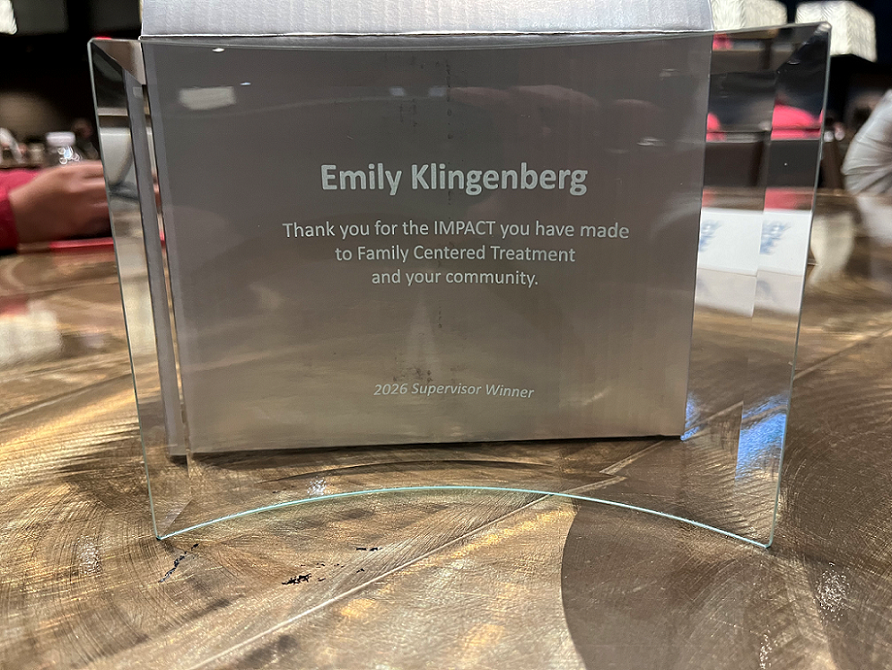
Recently, Emily traveled to Maryland to accept an award with her name engraved on it. She’s reflected on its significance and who truly deserves the recognition.
“This wouldn’t work if LSS hadn’t fully committed to it,” she says. “It wouldn’t be happening without clinicians willing to do this work.”
She names her co-supervisor. Her trainers. LSS leadership who said yes eight years ago and kept saying yes. County partners who trusted the program early. Families who showed up and did the hard work.
Eight years. Twenty-eight counties. Fifteen team members. A national award. A recovery model unlike any other in the state.
A program that families and clinicians describe the same way: it feels different.
“Communities are where the magic happens,” Emily says. “I’ll always advocate for work like this.”